
Kusa Jātaka
The King Who Found True Love
In the opulent city of Bhaddanagarā, ruled a king named Kusa. He was a man of great power and influence, yet his heart was heavy with a sorrow he could not quite articulate. He had a queen, Sudhammā, renowned for her beauty and grace, but their union, though blessed by the kingdom, lacked the warmth of true connection. Kusa often found himself drawn to the tales of ancient heroes and their epic quests, perhaps seeking a reflection of something missing in his own life.
One day, a mysterious omen appeared in the sky – a constellation that signaled a profound change. Driven by an inexplicable urge, King Kusa decided to undertake a perilous journey, leaving his kingdom under the care of his trusted ministers. His destination was unknown, his purpose unclear, but he felt compelled to seek something more, something real.
His travels took him to a distant land, where he encountered a maiden named Pabhavati. She was not of royal blood, nor was she adorned with jewels, but there was a radiant purity about her, a simplicity that captivated Kusa's heart. They met by chance, near a tranquil stream, and in her gentle eyes, Kusa saw a reflection of his own yearning for genuine affection. He fell deeply in love with her, a love unlike anything he had ever known.
He confessed his feelings, and Pabhavati, sensing the sincerity in his words, reciprocated his affection. They spent their days exploring the serene landscapes, their conversations flowing like the nearby stream, filled with understanding and mutual respect. Kusa, for the first time, felt a sense of true belonging, a peace that his royal life had never afforded him.
However, the duties of his kingdom weighed upon him. He could not abandon his people. Reluctantly, he revealed his identity to Pabhavati, explaining his royal obligations. Pabhavati, though saddened by the prospect of separation, understood. She agreed to wait for him, their hearts intertwined despite the distance.
Kusa returned to Bhaddanagarā, but his heart remained in the distant land with Pabhavati. His queen, Sudhammā, noticed his melancholy and grew suspicious. She learned of his clandestine love affair and, consumed by jealousy, devised a cruel plan. She sent emissaries to Pabhavati, carrying a false message that Kusa had abandoned her and urging her to return to Bhaddanagarā under false pretenses.
Pabhavati, heartbroken and deceived, believed the message. She traveled back to Bhaddanagarā, only to be met with the cold indifference of Sudhammā. The queen, reveling in her deception, treated Pabhavati as a mere servant, stripping her of her dignity and hope.
Meanwhile, King Kusa, tormented by the separation, learned of Sudhammā's treachery. Enraged by her cruelty and realizing the depth of his queen's deceit, he confronted her. He saw the emptiness in Sudhammā's actions, a stark contrast to the pure love he shared with Pabhavati. He banished Sudhammā, her jealousy having cost her everything.
Kusa then sought out Pabhavati, finding her in a state of despair. He embraced her, his love unwavering, and declared her his true queen. Together, they returned to the palace, where Kusa ruled with Pabhavati by his side, their reign marked by justice, compassion, and a love that had weathered trials and emerged stronger. The kingdom rejoiced, for their king had found not only a queen but a soulmate, proving that true love, though tested, can indeed conquer all.
— In-Article Ad —
💡Moral of the Story
True love and genuine connection are more valuable than titles or possessions, and deception and jealousy ultimately lead to ruin.
Perfection: Love (Priya) and Patience (Khanti)
— Ad Space (728x90) —
More Jataka Tales You May Enjoy
 262Tikanipāta
Dhammapala Jataka
Dhammapala JatakaIn the ancient kingdom of Kosala, there lived a Bodhisattva who was destined to bec...
💡 Deception and malice can be overcome by truth, integrity, and unwavering virtue. Those who seek to harm others through falsehood will ultimately be exposed and defeated.
 171Dukanipāta
Mahīsosaka Jātaka
Mahīsosaka JātakaIn the ancient kingdom of Mithila, nestled amongst rolling hills and verdant forest...
💡 True loyalty and affection cannot be bought or coerced. The worth of a creature, or a person, is not determined by external forces but by their inner spirit and their bonds with those who truly care for them.
159DukanipātaNimi Jataka
Nimi JatakaIn the ancient land of Videha, there ruled a king named Nimi. King Nimi was a paragon of ...
💡 Understanding the law of karma and the consequences of one's actions is essential for cultivating virtue and progressing towards liberation.
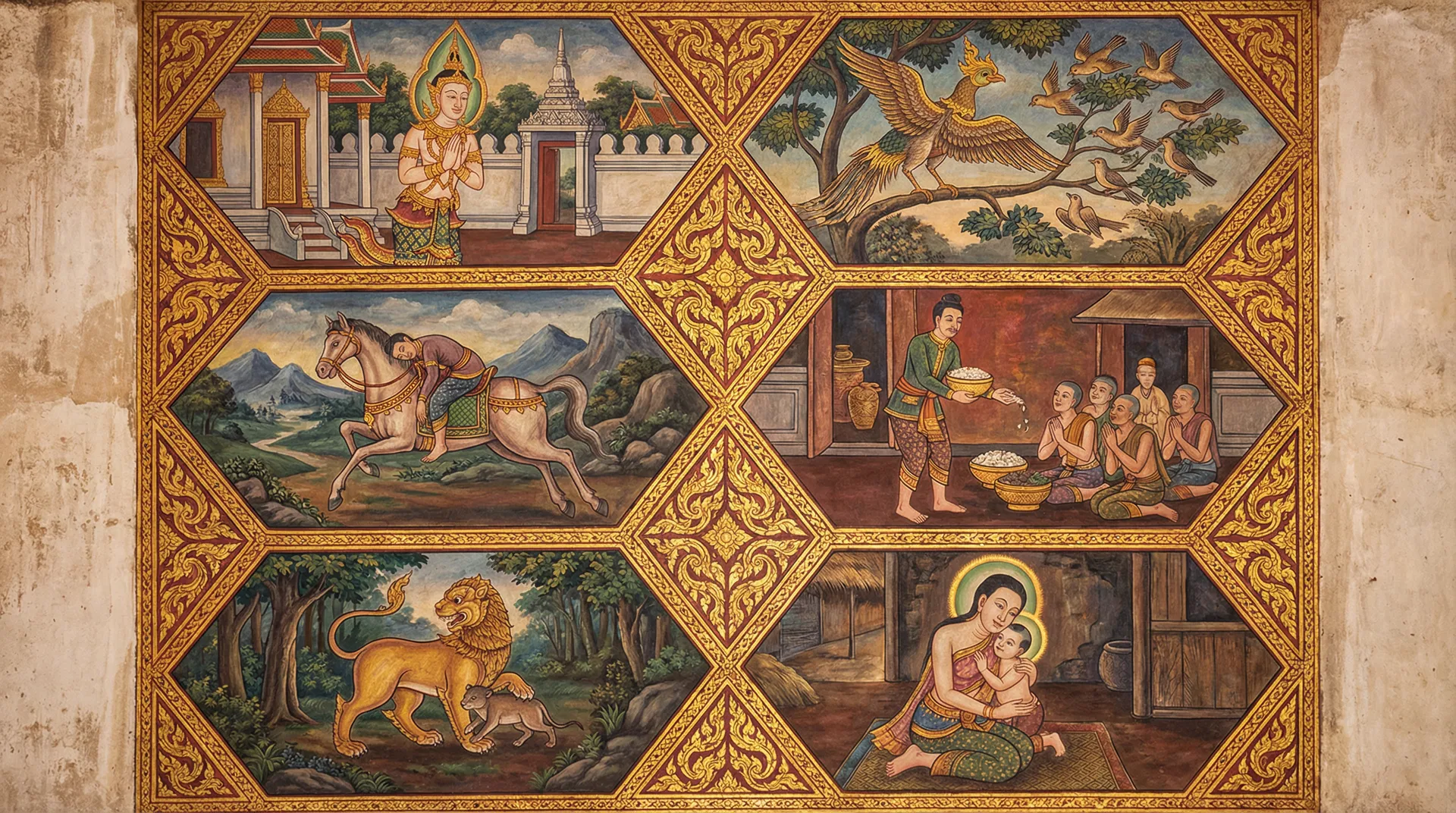 380Chakkanipāta
Mahā-bodhijātaka
Mahā-bodhijātakaIn the celestial realm, where clouds of pure light drifted and music of the spheres ...
💡 True generosity lies in giving selflessly, with a pure heart, and without attachment to one's possessions or the outcome. Greed and possessiveness diminish the value of any gift, while selfless giving brings the greatest joy.
 144Ekanipāta
Maca Hamsa Jataka
The Tale of the Golden Swan King In the realm of the Himalayas, amidst snow-capped peaks and crystal...
💡 True wealth lies in inner virtue, wisdom, and compassion, not in material possessions which are transient.
203DukanipātaKacchapa Jataka
Kacchapa Jataka In the heart of a lush jungle, where ancient trees formed a canopy of emerald and th...
💡 Selfless compassion and sacrifice are the highest forms of generosity. True spiritual growth requires understanding the interconnectedness of all beings and practicing kindness.
— Multiplex Ad —